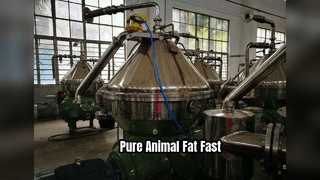
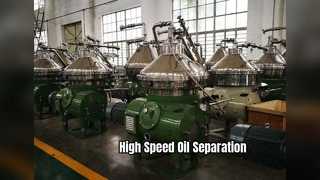
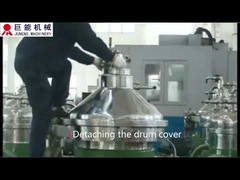
Brief: Explore what sets this solution apart in an easy-to-follow presentation. This video provides a detailed walkthrough of the solid wall design disc oil centrifugal separator, demonstrating how it efficiently clarifies animal oils and separates liquids from low-solids content feed. You'll see its operational principles, key applications in animal and vegetable oil processing, and learn why its high G-force and cost-effective manual solids removal make it a reliable choice for B2B oil production.
Related Product Features:
Solid wall bowl design retains separated solids within the disc stack for efficient liquid/solids or liquid/liquid separation.
Operates at a controlled inlet pressure of 0.05 Mpa, suitable for processes with low solids content (up to 1% by volume).
Achieves high G-force for effective recovery of fine particles, ensuring optimal oil clarity and quality.
Manual solids removal system simplifies design, reducing complexity and maintenance costs compared to automated models.
Versatile application for clarifying various animal oils like fish oil and vegetable oils including soybean, palm, and corn oil.
Cost-effective solution without a control box, offering a lower price point for businesses seeking reliable separation technology.
Available in multiple models (e.g., DHZ360, DRZ550) with treatment capacities ranging from 1200 to 30000 L/H to suit different production scales.
Compact and robust construction with outlined dimensions tailored for industrial settings, supporting maximized production capacity.
FAQs:
What is the main application of this solid wall design disc oil centrifugal separator?
This separator is primarily used for clarifying animal oils, such as fish oil, and various vegetable oils. It efficiently separates two liquids or clarifies one liquid from solids when the solids content in the feed is low (up to about 1% by volume).
How does the solids removal process work in this separator?
The solid wall bowl design retains separated solids within the disc stack. Since it lacks an automatic discharge system, all solids are removed manually, which simplifies the design and reduces costs compared to self-cleaning models.
What are the advantages of using this separator over automated models?
This separator offers a cost-effective solution due to its simpler design without a control box or hydraulic system. It achieves high G-force for efficient separation of fine particles, making it reliable for processes with low solids content, while being more affordable than automatic control separators.
What is the treatment capacity range for the different models available?
The separator comes in various models, such as DHZ360 and DRZ550, with treatment capacities ranging from 1200 L/H to 30000 L/H, allowing businesses to select a model that fits their specific production volume needs.